Balancing without measuring only moves the problem around. The numbers come first, the cause second and the adjustments last.
Service · Alhambra, CA
Hot and Cold Rooms From Duct Problems in Alhambra, CA
When one room is always too hot and another too cold, the thermostat and the equipment are often fine. The difference is in how much air each room receives, and that is a duct question before it is an equipment question.
What you are seeing
Patterns of uneven rooms
- Far bedroom too warm
The room at the end of the longest run receives the least air.
- Front room too cold
The shortest run delivers more than the room needs.
- Upstairs or addition
A room added later is fed by an undersized branch.
- West-facing room
Afternoon sun overwhelms a supply that suits other rooms.
How it works
Why the thermostat room is not every room
A thermostat measures one place. Air delivered to other rooms depends on the length and size of each run, the leaks along it and whether the room can return air back to the system.
- Long runs
Friction reduces the air that reaches the end of the branch.
- Leaky branches
Air escapes before the register.
- Closed doors
A shut bedroom door with no return path builds pressure and cuts supply.
- Sun load
A room with large west glass needs more cooling than its duct delivers.
Pressure is the hidden factor. When a bedroom door is closed and the room has no return path, the supply pressurizes the room, flow falls and the room warms. Opening the door often changes the temperature within an hour, which is a clear sign of a return problem.
Property type
Additions at the end of the line in Alhambra bungalows
Many Alhambra bungalows grew by adding a rear room, a converted garage or an attic bedroom. The new space often hangs off an existing duct that was sized for the original house.
- Converted garage
A room with no direct run depends on a long, thin branch.
- Back bedroom
The end of a long run receives the weakest flow.
- Hallway return
A single central return leaves closed rooms starved of a return path.
Technique
How airflow is measured and balanced
Map the temperatures
Each room's temperature is recorded with the system running.
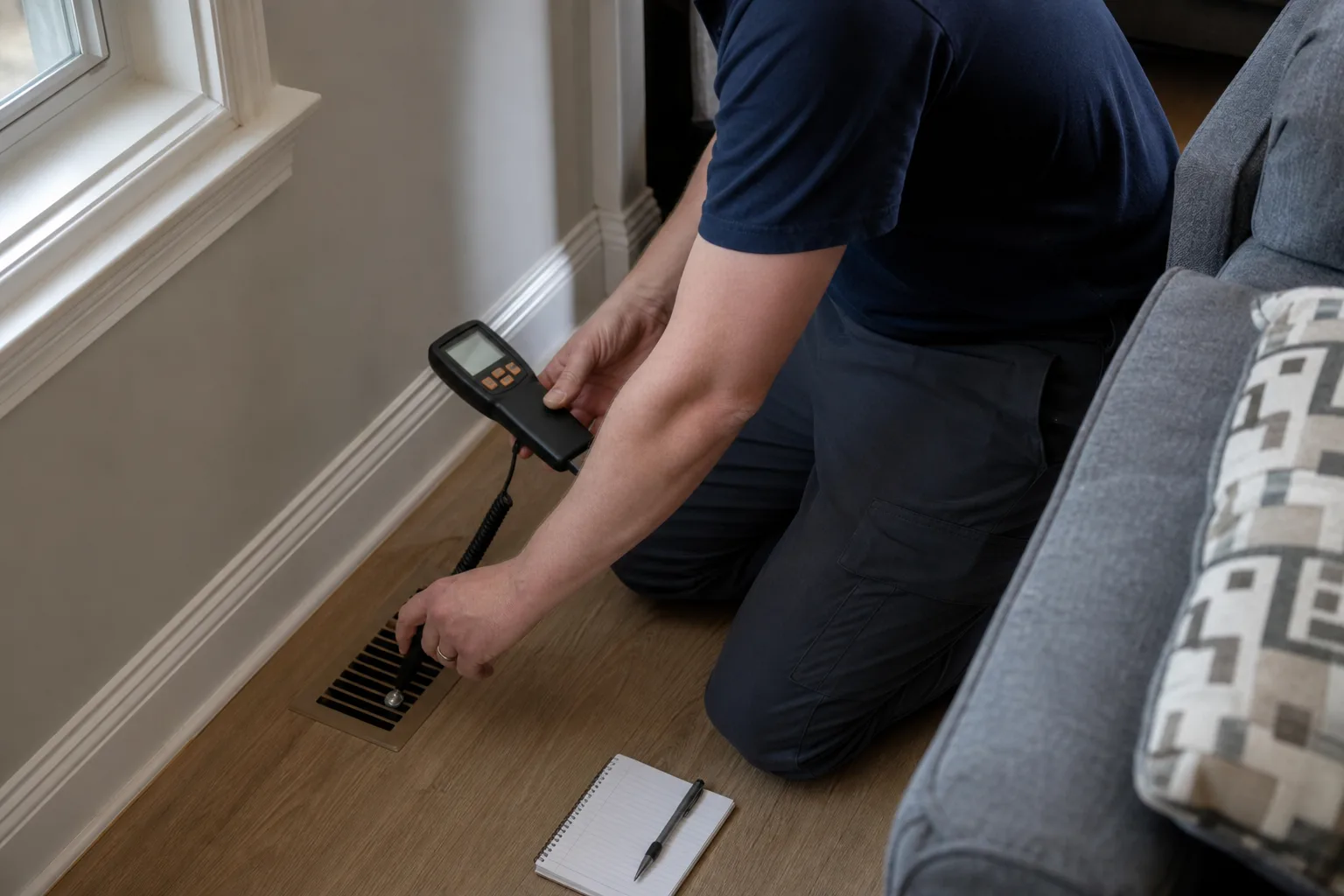
Measure the registers
Air volume at every register is compared with the room's needs.
Find the cause
Leaks, restrictions, undersized runs or return problems are located.
Adjust dampers
Balancing dampers are set to move air toward the starved rooms.
Recheck
Temperatures and flow are measured again after the changes.
Name the hottest and coldest rooms and whether either was added later, and the likely cause can be narrowed.
(626) 687-0603Phase order
Measure, locate, balance
Rooms are measured on a day that stresses the system, such as a warm afternoon, because a mild day hides the imbalance.
Local detail
West windows and afternoon sun
Afternoon sun in Alhambra, Los Angeles County, strikes west-facing rooms hardest between four and seven in the evening. A duct that delivers enough air at noon may fall short exactly when those rooms need it most.
Triage order
Corrections for each uneven-room cause
- Closed damper
Reopened and set.
- Leaking branch
Repaired and sealed.
- Undersized run
Enlarged or supplemented, as the independent technician scopes on site.
- Return path
A transfer grille or jumper duct lets air return from closed rooms.
Measured results
Proof that the rooms are balanced
- Temperature spread
Rooms sit within a few degrees of the thermostat.
- Register flow
Each register delivers close to the volume its room needs.
- Closed-door test
A shut bedroom door does not starve the room of air.
Documentation
What to note about the uncomfortable rooms
The technician works faster with a simple record. Note which rooms are too hot or too cold, at what time of day, whether doors are open or closed, and whether the room was part of the original house or added later.
Safety protocol
Adjustments a homeowner can try
- Open the doors
See whether the room changes with the door ajar.
- Clear the registers
Furniture and curtains block supply and return grilles.
- Use blinds
Closing west-facing blinds before the afternoon reduces the sun load.
Scope: Emergency diagnostic dispatch, whole system replacement and ductwork replacement only. Scope and pricing are provided directly by independent licensed contractors.
Common questions
Questions about hot and cold rooms in Alhambra
Is room balancing available in 91801, 91803 and 91804?
This guidance covers Alhambra homes in ZIP codes 91801, 91803 and 91804.
Why is one room always hotter than the rest?
It usually receives less air, because of a long or leaking run, a closed damper, a weak return or a heavy sun load.
Will a new thermostat fix uneven rooms?
Rarely. A thermostat measures one location, and rooms differ because of the ducts and the sun, not the control.
Does closing a vent help the rest of the house?
Not usually. Closing a register raises pressure in the duct and can increase leakage elsewhere.
A heating or cooling fault rarely fixes itself.
Call and describe the problem in Alhambra: what the system is doing, what it did first and how old the equipment is.