A heat pump moves heat instead of making it. In cooling mode it carries heat out of the house, and in heating mode a reversing valve swaps the roles of the two coils so the outdoor coil gathers heat from the air and the indoor coil releases it.
Service category · Alhambra, CA
Heat Pump Services in Alhambra, CA
A ducted heat pump is an air conditioner that can run backward, and that one extra part changes how it fails. In Alhambra's mild winters the system does both jobs in one outdoor unit, so a single fault can leave a house without heat in January and without cooling in August.
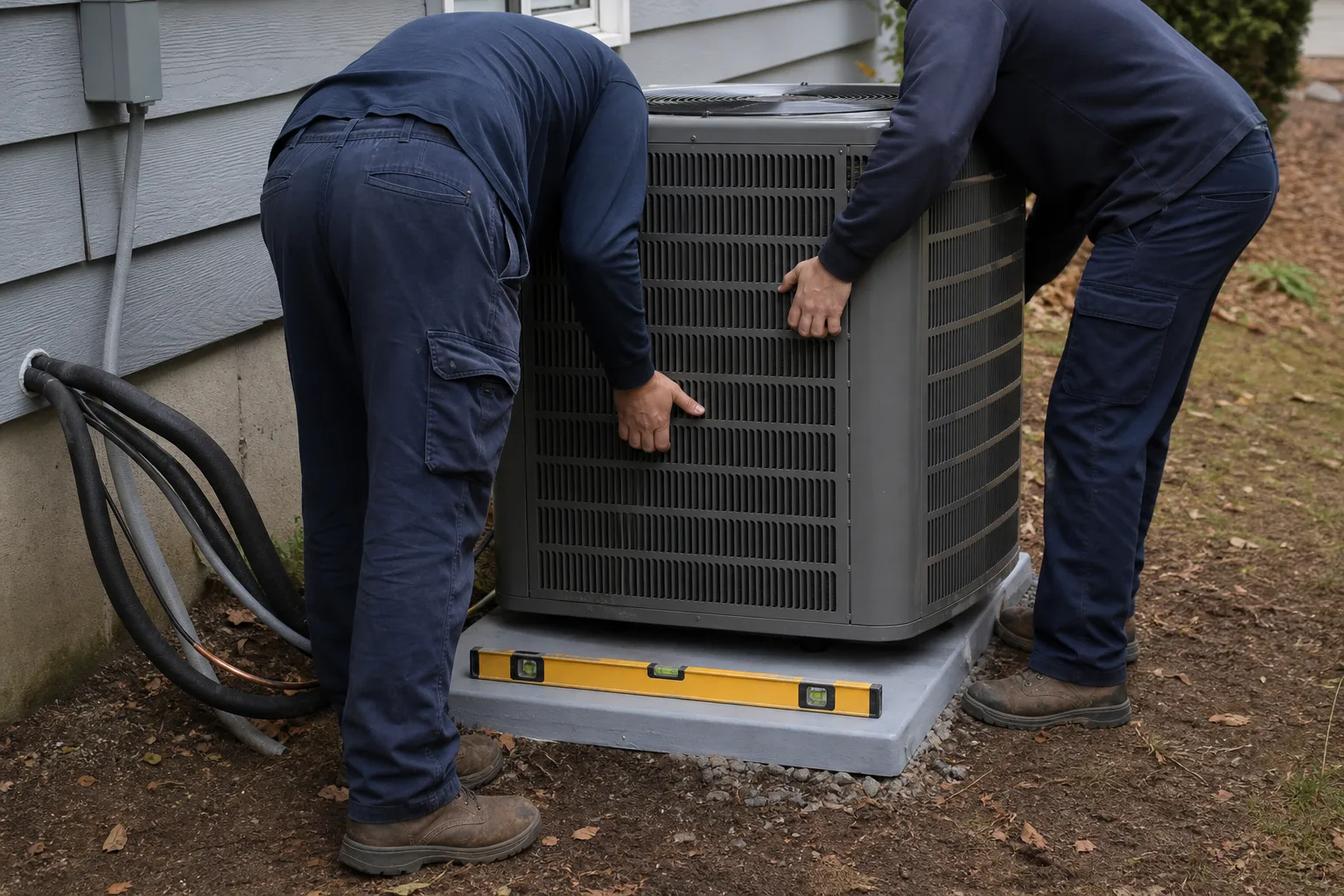
What you are seeing
Heat pump symptoms and the mode they point to
- Works in one mode only
Cooling is fine but heating is weak, or the reverse, which separates a mode fault from a general one.
- Cool air in heating mode
Supply air that feels cooler than a furnace may be normal, or may signal a failed defrost or a locked-out heat strip.
- Frost or ice outside
A light frost on a cold morning is expected, while a solid block of ice around the unit is not.
- Loud hiss or whoosh
A brief sound at a mode change is normal, and a continuous one points at the reversing valve.
- System runs constantly
A unit that never satisfies the thermostat has lost capacity somewhere.
How it works
How one refrigerant circuit both heats and cools
Even cool outdoor air holds usable heat, which is why a heat pump suits a climate like Alhambra's. The parts that make this work are the ones that differ from a plain air conditioner.
As outdoor air cools, a heat pump gathers less heat from it, and below a certain temperature the system leans on auxiliary strips to make up the difference. That crossover is called the balance point, and in Alhambra it is reached only on the coldest nights.
- Reversing valve
A solenoid-driven slide that redirects refrigerant flow when the mode changes.
- Defrost control
A board and sensor that briefly run the system in cooling mode to melt frost off the outdoor coil.
- Auxiliary heat
Electric strips in the air handler that add heat when the heat pump alone cannot keep up.
Property type
Electrical limits in older Alhambra homes
Many Alhambra bungalows in ZIP codes 91801 and 91803 were wired decades before a heat pump was imagined, and the main panel may be small. Electric auxiliary strips draw a heavy load, so a new or replaced heat pump has to fit within the service capacity of the house.
- Panel capacity
A full panel limits what can be added without a service upgrade.
- Attic air handlers
Heat strips and control boards age in summer attic heat.
- Condensate paths
Heating mode drains water from the outdoor unit, so its base needs a clear path.
- Duct condition
Heat pump air is gentler than furnace air, so leaky or crushed attic ducts show up as cold rooms.
Technique
How a heat pump fault is separated into modes
A technician diagnoses a heat pump by mode first, because knowing which mode fails narrows the cause considerably.
Which mode
Cooling, heating or both, and what the thermostat is set to.
Electrical readings
Capacitor values and compressor and fan amperage against the rating.
Reversing valve
Whether the valve shifts when the thermostat changes mode, by temperature of the lines.
Defrost operation
The defrost board, sensor and the outdoor coil are watched through a cycle.
Auxiliary heat
Strips and sequencers are tested for staging and for runaway operation.
Tell the call which mode is failing and what the outdoor unit is doing, and it can point you to the right next step.
(626) 687-0603Phase order
From a mode complaint to a working system
The order moves from the thermostat settings through the electrical parts, then the reversing valve and defrost, and ends with sealed-system work. A leak or a valve replacement is the longest job, since the refrigerant must be recovered, the repair made and the circuit evacuated and charged by weight.
Triage order
Where to go next: repair, replace or compare
The pages below cover repairs by symptom, installation and replacement, and the question many homeowners ask first: whether a heat pump or a furnace with an air conditioner fits the house. Each page explains what a technician checks and what the work involves.
- Repair
A failed capacitor, board, contactor or valve on a system that is otherwise sound.
- Replace
A failed compressor, a leaking coil or a system near the end of its life.
- Compare
A homeowner weighing a heat pump against a furnace and air conditioner pair.
Choose your situation
Heat pump services, by situation
- Heat Pump RepairThe parts that fail first on a ducted heat pump and how a repair is diagnosed and proven.
- Heat Pump Not Heating or CoolingCooling but no heat, heat but no cooling, or neither: how the failing mode narrows the cause.
- Heat Pump Installation and ReplacementElectrical supply, thermostat setup, drainage and dual-mode commissioning for a ducted heat pump replacement.
- Heat Pump or Furnace and AC: How to DecideA decision guide: heat pump or furnace and air conditioner, weighed on climate, supply, ducts and panel.
- Heat Pump Blowing Cold Air in Heating ModeCool-feeling air in heating mode: normal supply temperature, defrost cycles, strips and the reversing valve.
- Heat Pump Reversing Valve ProblemsA stuck or leaking reversing valve: wrong-mode operation, hissing, poor capacity and what repair involves.
- Heat Pump Outdoor Unit IcingNormal frost versus a block of ice on the outdoor unit: failed defrost, blocked airflow, drainage and charge.
Measured results
What a finished heat pump repair should show
- Both modes work
Heating and cooling each reach their setpoints in turn.
- Valve shifts cleanly
The lines change temperature as expected when the mode switches.
- Defrost completes
Frost clears and the unit returns to heating on its own.
- Amperage in range
Compressor and fan current stay at or below the nameplate rating.
Local detail
Why a heat pump fits Alhambra's weather
Winter lows in Alhambra, Los Angeles County, settle in the mid forties, which is well inside the range a ducted heat pump handles without leaning on its auxiliary heat. The same system faces long cooling seasons, so wear shows up in both directions.
Documentation
Permits and Title 24 for a heat pump swap
A capacitor or board swap needs no permit, but replacing a heat pump is regulated work under California's Title 24. The permit is issued by the City of Alhambra Building Division, and the installing technician normally pulls it.
When ducts are altered, a third-party rater verifies duct leakage and airflow before the permit closes. Ask who handles each step before agreeing to the work.
Safety protocol
Safe handling while the system is down
- Do not chip ice
Scraping the outdoor coil can puncture it.
- Breaker off for burning odor
Auxiliary strips can overheat, so shut the system off if you smell burning.
- Leave refrigerant alone
The lines and service ports are regulated and are never a homeowner task.
- Check on vulnerable residents
Move children and older relatives to the warmest or coolest room, depending on the season.
Scope: Emergency diagnostic dispatch, whole system replacement and ductwork replacement only. Scope and pricing are provided directly by independent licensed contractors.
Common questions
Heat pump questions from Alhambra homeowners
Which Alhambra ZIP codes do heat pump pages cover?
This site covers Alhambra homes in ZIP codes 91801, 91803 and 91804, within Los Angeles County.
Is frost on a heat pump outdoor unit normal?
A thin layer on a cold, damp morning is normal, because the unit runs a defrost cycle. A thick, persistent block of ice is a fault.
Why does heat pump air feel cooler than furnace air?
A heat pump delivers warm air at a lower temperature than a gas furnace, so it can feel mild at the register while still heating the house.
Does replacing a heat pump need a permit in Alhambra?
Yes. A replacement is permitted through the City of Alhambra Building Division and falls under Title 24.
What should I say when I call about a heat pump?
Name the mode that is failing, what the outdoor unit is doing and whether auxiliary heat comes on. A sound, ice or a burning smell narrows the cause further.
A heating or cooling fault rarely fixes itself.
Call and describe the problem in Alhambra: what the system is doing, what it did first and how old the equipment is.